Laws of Motion – Class 9 Science Question & Answers (Maharashtra Board)
Exercises
- Match the first column with appropriate entries in the second and third columns and remake the table.
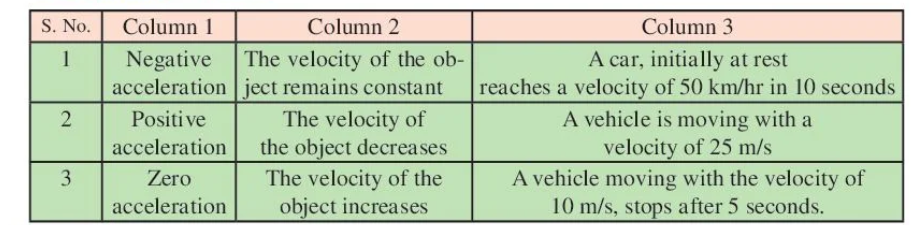
Answer
| S. No. | Column 1 | Column 2 | Column 3 |
|---|---|---|---|
| 1 | Negative acceleration | The velocity of the object decreases | A vehicle moving with the velocity of 10 m/s, stops after 5 seconds. |
| 2 | Positive acceleration | The velocity of the object increases | A car, initially at rest reaches a velocity of 50 km/hr in 10 seconds. |
| 3 | Zero acceleration | The velocity of the object remains constant | A vehicle is moving with a velocity of 25 m/s. |
Solution
1. Negative acceleration: Negative acceleration means that the velocity of an object decreases with time. Therefore, it matches with:
The velocity of the object decreases
A vehicle moving with the velocity of 10 m/s, stops after 5 seconds.
2. Positive acceleration: Positive acceleration means that the velocity of an object increases with time. Therefore, it matches with:
The velocity of the object increases
A car, initially at rest reaches a velocity of 50 km/hr in 10 seconds.
3. Zero acceleration: When acceleration is zero, the velocity remains constant. Therefore, it matches with:
The velocity of the object remains constant
A vehicle is moving with a velocity of 25 m/s.
| Distance | Displacement |
|---|---|
| Distance is the total length of the actual path travelled by an object. | Displacement is the shortest distance between the initial and final positions of an object, measured in a particular direction. |
| It is a scalar quantity because it has only magnitude. | It is a vector quantity because it has both magnitude and direction. |
| Distance is always positive or zero. | Displacement can be positive, negative, or zero depending on the chosen direction. |
| Distance depends on the actual path followed by the object. | Displacement depends only on the initial and final positions. |
| Distance can never be less than the magnitude of displacement. | The magnitude of displacement can be equal to or less than the distance travelled. |
Example: Suppose a person walks 5 m east and then 3 m west.
Distance = 5 + 3 = 8 m
Displacement = 5 - 3 = 2 m east
Thus, distance tells us how much path was actually covered, while displacement tells us how far and in which direction the object has moved from its initial position.
| Uniform Motion | Non-uniform Motion |
|---|---|
| An object is said to be in uniform motion when it covers equal distances in equal intervals of time. | An object is said to be in non-uniform motion when it covers unequal distances in equal intervals of time. |
| The velocity remains constant if the direction of motion also remains unchanged. | The velocity changes with time because the speed or direction, or both, may change. |
| Acceleration is zero for uniform motion when velocity remains constant. | Acceleration is generally non-zero when the velocity changes. |
| Example: A car moving at a constant velocity of 20 m/s on a straight road. | Example: A car moving through a busy road, where its speed keeps increasing or decreasing. |
In simple words: In uniform motion, the object moves at a constant rate. In non-uniform motion, the rate of motion changes with time.
3. Complete the following table.
The formulas given in the question are:
{v = u + at }{s = ut + (1/2)at² }
| u (m/s) | a (m/s²) | t (sec) | v = u + at (m/s) |
|---|---|---|---|
| 2 | 4 | 3 | 14 |
| 10 | 5 | 2 | 20 |
Solution
First row
Given:
u = 2 m/s, a = 4 m/s², t = 3 s
Using:
{v = u + at }{v = 2 + (4 × 3) }{v = 2 + 12 }{[v = 14 m/s] }
Therefore, the missing value is 14 m/s.
Second row
Given:
v = 20 m/s, a = 5 m/s², t = 2 s
Using:
v = u + at
Rearranging:
{u = v - at }{u = 20 - (5 × 2) }{u = 20 - 10 }Therefore, the missing value is 10 m/s.
| u (m/s) | a (m/s²) | t (sec) | s = ut + (1/2)at²(m) |
|---|---|---|---|
| 5 | 12 | 3 | 69 |
| 7 | 8 | 4 | 92 |
Solution
First row
Given:
u = 5 m/s, a = 12 m/s², t = 3 s
Using:
s = ut + (1/2)at²
Substituting the values:
{s = (5 × 3) + (1/2)(12)(3)² }{[s = 69 m] }
Therefore, the missing value is 69 m.
Second row
Given:
u = 7 m/s, t = 4 s, s = 92 m
We need to find acceleration a.
Using: 92 = (7 × 4) + (1/2)a(4)² {92 = 28 + 8a }{92 - 28 = 8a }{64 = 8a }{[a = 8 m/s²] }
Therefore, the missing value is 8 m/s².
| u (m/s) | a (m/s²) | s (m) | v² = u² + 2as(m/s)² |
|---|---|---|---|
| 4 | 3 | −4/3 m | 8 |
| No real value | 5 | 8.4 | 10 |
solution
Given:
Acceleration, a = 5 m/s²
Displacement, s = 8.4 m
Final velocity, v = 10 m/s
Using the equation:
v² = u² + 2as
Substituting the values:
10² = u² + 2(5)(8.4)
100 = u² + 84
u² = 100 - 84
u² = 16
Taking the square root:
[u = 4 m/s]
Answer: The missing initial velocity is 4 m/s.
The important point is that the table's entry is the final velocity v = 10 m/s, so we must use 10² = 100in the equation.
4. Complete the sentences and explain them.
a. The minimum distance between the start and finish points of the motion of an object is called the ……….. of the object.
Answer: Displacement.
Explanation: Displacement is the shortest straight-line distance between the initial and final positions of an object, measured in a specific direction. It is a vector quantity.
b. Deceleration is ………………………. acceleration
Answer: Deceleration is negative acceleration.
Explanation: Deceleration is the rate at which the velocity of an object decreases with time. It acts opposite to the direction of velocity when an object is slowing down.
c. When an object is in uniform circular motion, its ………………………. changes at every point.
Answer: Velocity.
Explanation: In uniform circular motion, the speed of the object remains constant, but its direction of motion changes continuously. Since velocity depends on both speed and direction, the velocity changes at every point of the circular path.
d. During collision ………………………. remains constant.
Answer: Momentum.
Explanation: During a collision, the total momentum of an isolated system remains constant, provided no external net force acts on the system. This is known as the law of conservation of momentum.
e. The working of a rocket depends on Newton’s ………………………. law of motion.
Answer: Third.
Explanation: Newton’s third law states that every action has an equal and opposite reaction. A rocket expels gases at high speed in the backward direction. The gases exert an equal and opposite force on the rocket, propelling it forward.
5. Give scientific reasons.
a. When an object falls freely to the ground, its acceleration is uniform.
Answer:
A freely falling object moves under the influence of Earth's gravitational force, when air resistance is neglected. Near the Earth's surface, the acceleration due to gravity remains approximately constant at 9.8 m/s², directed downward.
Therefore, the velocity of the object increases by approximately 9.8 m/severy second, making its acceleration uniform.
b. Even though the magnitudes of action force and reaction force are equal and their directions are opposite, their effects do not get cancelled.
Answer:
According to Newton’s third law of motion, action and reaction forces are equal in magnitude and opposite in direction. However, these forces act on two different objects, not on the same object.
For example, when a person pushes a wall, the person exerts a force on the wall, and the wall exerts an equal and opposite force on the person. Since the forces act on different objects, they do not cancel each other.
The effect of each force depends on the net force acting on the particular object.
c. It is easier to stop a tennis ball as compared to a cricket ball, when both are traveling with the same velocity.
Answer:
The momentum of a moving object is given by:
p = mv
A cricket ball has a greater mass than a tennis ball. When both balls move with the same velocity, the cricket ball has greater momentum.
According to Newton’s second law, a greater change in momentum requires a greater impulse or force for the same stopping time. Therefore, a tennis ball is easier to stop because it has less momentum.
d. The velocity of an object at rest is considered to be uniform.
Answer:
An object at rest has zero velocity. If it remains at rest, its velocity does not change with time.
Since acceleration is the rate of change of velocity, the acceleration is zero. Therefore, the object is considered to be in uniform motion with constant zero velocity.
6. Take 5 examples from your surroundings and give an explanation based on Newton’s laws of motion.
Answer
1. A passenger moves forward when a moving bus stops suddenly.
Newton’s first law of motion: An object continues in its state of rest or uniform motion unless acted upon by an external unbalanced force.
Explanation: When a moving bus stops suddenly, the lower part of a passenger's body stops with the bus, but the upper part tends to continue moving forward due to inertia of motion. This is why the passenger may lean forward.
2. A football moves when it is kicked.
Newton’s second law of motion: The acceleration of an object depends on the net force applied and its mass.
F = ma
Explanation: When a player kicks a stationary football, the applied force produces acceleration and changes the ball's velocity. A harder kick generally produces a greater change in velocity, provided other conditions remain similar.
3. A swimmer pushes water backward and moves forward.
Newton’s third law of motion: Every action has an equal and opposite reaction.
Explanation: A swimmer pushes water backward with their hands and feet. The water exerts an equal and opposite force on the swimmer, helping them move forward.
4. A person jumps off a boat and the boat moves backward.
Newton’s third law of motion: Forces between interacting objects are equal in magnitude and opposite in direction.
Explanation: When a person jumps forward from a boat, they exert a backward force on the boat. The boat experiences an opposite force and moves backward, assuming the water and other resistive forces do not prevent the motion.
5. A seat belt protects a passenger during sudden braking.
Newton’s first law of motion: A moving object tends to continue moving unless an external force acts on it.
Explanation: When a car brakes suddenly, the passenger's body tends to move forward due to inertia. The seat belt applies a force that slows the passenger along with the car, reducing the risk of injury.
7. Solve the following examples.
a) An object moves 18 m in the first 3 s, 22 m in the next 3 s and 14 m in the last 3 s. What is its average speed? (Ans: 6 m/s)
Answer
Given:
Distance covered in the first 3 seconds = 18 m
Distance covered in the next 3 seconds = 22 m
Distance covered in the last 3 seconds = 14 m
Formula:
Average speed = (Total distance/Total time)
Calculate the total distance.
Total distance = 18 + 22 + 14
= 54 m
Calculate the total time.
Total time = 3 + 3 + 3 = 9 s
Calculate the average speed.
Average speed = (54/9)
[Average speed = 6 m/s]
Final answer: 6 m/s.
b) An object of mass 16 kg is moving with an acceleration of 3 m/s2. Calculate the applied force. If the same force is applied on an object of mass 24 kg, how much will be the acceleration? (Ans: 48 N, 2 m/s2)
Answer
Given:
Mass of the first object, m₁ = 16 kg
Acceleration of the first object, a₁ = 3 m/s²
Mass of the second object, m₂ = 24 kg
Calculate the applied force.
According to Newton’s second law of motion:
F = ma
Substituting the values:
F = 16 × 3
[F = 48 N]
Therefore, the applied force is 48 N.
Calculate the acceleration of the second object.
The same force of 48 N is applied to an object of mass 24 kg.
Using:
a = (F/m)
a₂ = (48/24)
[a₂ = 2 m/s²]
Final answer:
Applied force = 48 N
Acceleration of the second object = 2 m/s²
c) A bullet having a mass of 10 g and moving with a speed of 1.5 m/s, penetrates a thick wooden plank of mass 90 g. The plank was initially at rest. The bullet gets embedded in the plank and both move together. Determine their velocity. (Ans: 0.15 m/s)
Answer
Given:
Mass of bullet, m₁ = 10 g = 0.01 kg
Initial velocity of bullet, u₁ = 1.5 m/s
Mass of wooden plank, m₂ = 90 g = 0.09 kg
Initial velocity of plank, u₂ = 0 m/s
Since the bullet gets embedded in the plank, both objects move together after the collision.
Principle used: Law of conservation of momentum.
Total initial momentum = Total final momentum
Write the momentum equation.
m₁u₁ + m₂u₂ = ( m₁ + m₂ )v
Substitute the values.
(0.01 × 1.5) + (0.09 × 0) = (0.01 + 0.09)v
0.015 = 0.10v
Calculate the final velocity.
v = (0.015/0.10)
[v = 0.15 m/s]
Final answer: The bullet and the wooden plank move together with a velocity of 0.15 m/s in the original direction of the bullet.
d) A person swims 100 m in the first 40 s, 80 m in the next 40 s and 45 m in the last 20 s. What is the average speed? (Ans: 2.25 m/s2)
Answer
Given:
Distance covered in the first 40 seconds = 100 m
Distance covered in the next 40 seconds = 80 m
Distance covered in the last 20 seconds = 45 m
Formula:
Average speed = (Total distance/Total time)
Calculate the total distance.
Total distance = 100 + 80 + 45
= 225 m
Calculate the total time.
Total time = 40 + 40 + 20
= 100 s
Calculate the average speed.
Average speed = (225/100)
[Average speed = 2.25 m/s]