Energy Flow in an Ecosystem
What Do You Mean by Ecosystem?
An ecosystem is a geographic area where plants, animals, and other organisms, as well as weather and landscape, work together to form a bubble of life. Ecosystems contain biotic (living) factors as well as abiotic (non-living) factors. Biotic factors include plants, animals, and other organisms. Abiotic factors include rocks, temperature, and humidity. Every part of an ecosystem depends on the others, directly or indirectly — the whole surface of the Earth is a series of connected ecosystems.
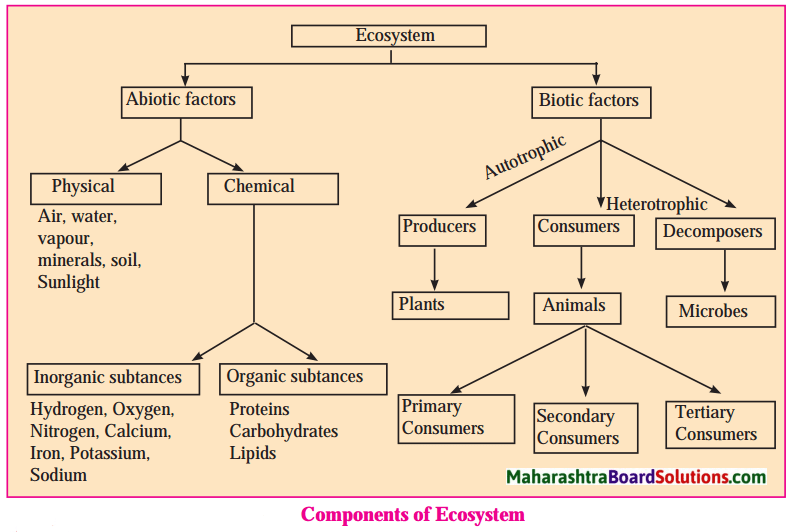
The structure which is formed due to these reciprocal relationships is called an ecosystem.
Types of Ecosystem
An ecosystem has large communities of living organisms that directly and indirectly interact with the physical environment. It is broadly divided into two categories: Terrestrial Ecosystems (Land-Based) and Aquatic Ecosystems (Water-Based).
Terrestrial Ecosystem (Land-Based)
It is a land-based ecosystem which is classified by its prevailing climate and vegetation. Its major types include:
- Forest ecosystem: A forest is not just a collection of trees but a complex living community. It brings together living things — diverse plants, animals, and microscopic organisms — and blends them with non-living elements like soil, water, and sunlight. Forests play two critical roles in keeping the Earth healthy:
- Climate Control: They act as natural air conditioners, helping to regulate and stabilize global temperatures.
- Carbon Sponges: They serve as massive "carbon sinks," absorbing and storing huge amounts of carbon dioxide from the atmosphere — essential for fighting climate change.
- Grassland ecosystem: Less dense than the forest ecosystem. These ecosystems host grazing animals, insectivores, and herbivores, and experience moderate temperatures. They are categorised into tropical grasslands (savannas), with seasonal dryness and various predators and grazers, and temperate grasslands (prairies), which lack large shrubs and trees.
Aquatic Ecosystem
These ecosystems are water-based and include freshwater ecosystems like rivers, lakes, and ponds, as well as marine ecosystems such as oceans, coral reefs, and estuaries.
Energy Flow in an Ecosystem
Energy transmission in an ecosystem is based on the thermodynamic laws of energy. The chemical energy of food is transmitted to different trophic levels along the food chain. Two laws govern the transmission of energy:
- First law of thermodynamics: Energy can neither be created nor destroyed — it can only change from one form to another.
- Second law of thermodynamics: As energy is transferred, more and more of it is wasted.
Trophic Level of Ecosystem
In ecology, a trophic level refers to a position in a food chain or ecological pyramid occupied by a group of organisms with similar feeding modes. The concept of trophic level was developed by Raymond Lindeman (1942). The trophic level of an organism is the number of steps it is from the start of the chain.
The trophic level has two major categories:
- The Autotrophs
- The Heterotrophs
- The Autotrophs: Organisms that can produce organic matter from inorganic matter. Since they can make their own food and do not need to feed on other organisms, they are also referred to as the producers of an ecosystem. Example: plants.
- The Heterotrophs: Unlike autotrophs, they do not have the ability to manufacture their food from inorganic sources. They hunt or gather food from other organisms, so they are referred to as consumers. Heterotrophs are further grouped as:
- Primary Consumers: Plant-eating organisms, called herbivores.
- Secondary Consumers: Feed on the primary consumers.
- Tertiary Consumers: Feed on the secondary consumers, and so on.
- Final Consumers: Also called reducers, they feed on dead organic matter and include the detritivores and the decomposers.
Food Chain and Food Web
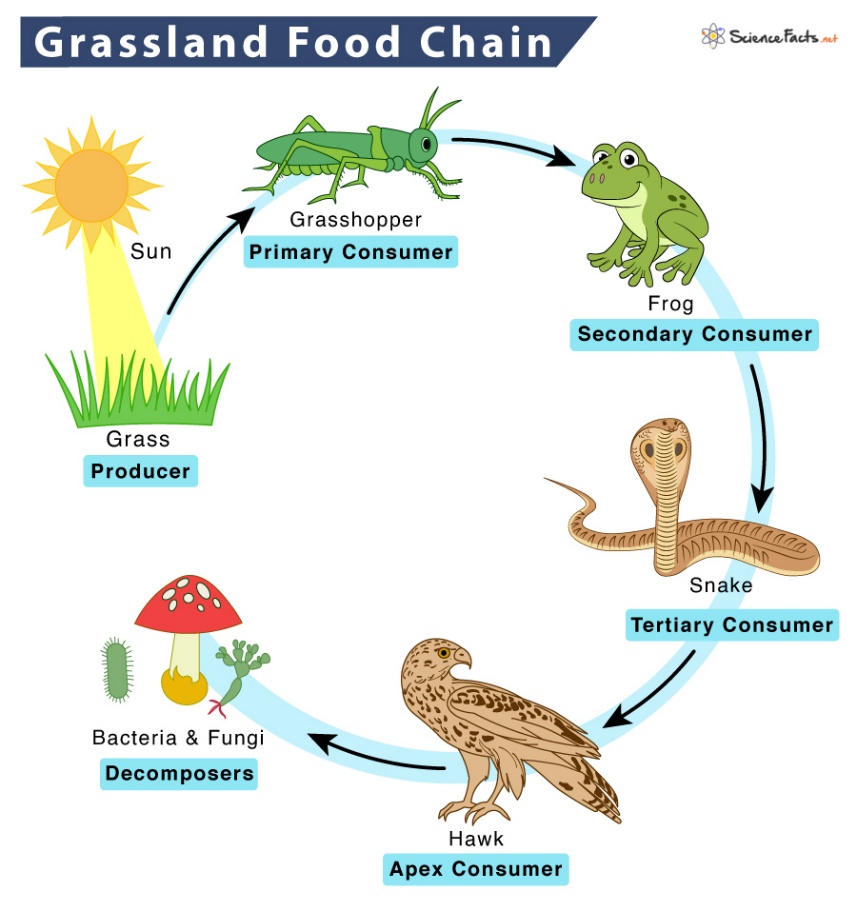
The transfer of food energy through a sequence of eating and being eaten by organisms in an ecosystem is termed the food chain.
For example, in a grassland ecosystem, grass fixes light energy from the sun into chemical energy via photosynthesis. A grasshopper eats the grass, a frog eats the grasshopper, and a snake eats the frog. So grass, grasshopper, frog, and snake make a food chain — energy contained in food is transferred from one organism to another.
Food Web
In nature, food chains never exist as isolated linear sequences — they are interconnected to form a network called a food web. A food web can be defined as a network of food chains interconnected so that a number of options of eating and being eaten are available at each trophic level.
(Recreate this as a proper diagram image when possible — shown here as text for now.)
In the diagram above, producers are the plants, trees, herbs, and shrubs that make their own food using sunlight, air, and water. Grasshoppers, mice, and rabbits are primary consumers because they eat producers (only plants). Frogs and foxes are secondary consumers because they eat primary consumers (grasshoppers, rabbits, etc.) — they are often carnivores (meat-eaters) or omnivores (eat both). Tertiary consumers are large carnivores that eat secondary consumers, often apex predators (nothing else hunts them). Examples: hawks, eagles, and wolves.
The Energy Pyramid
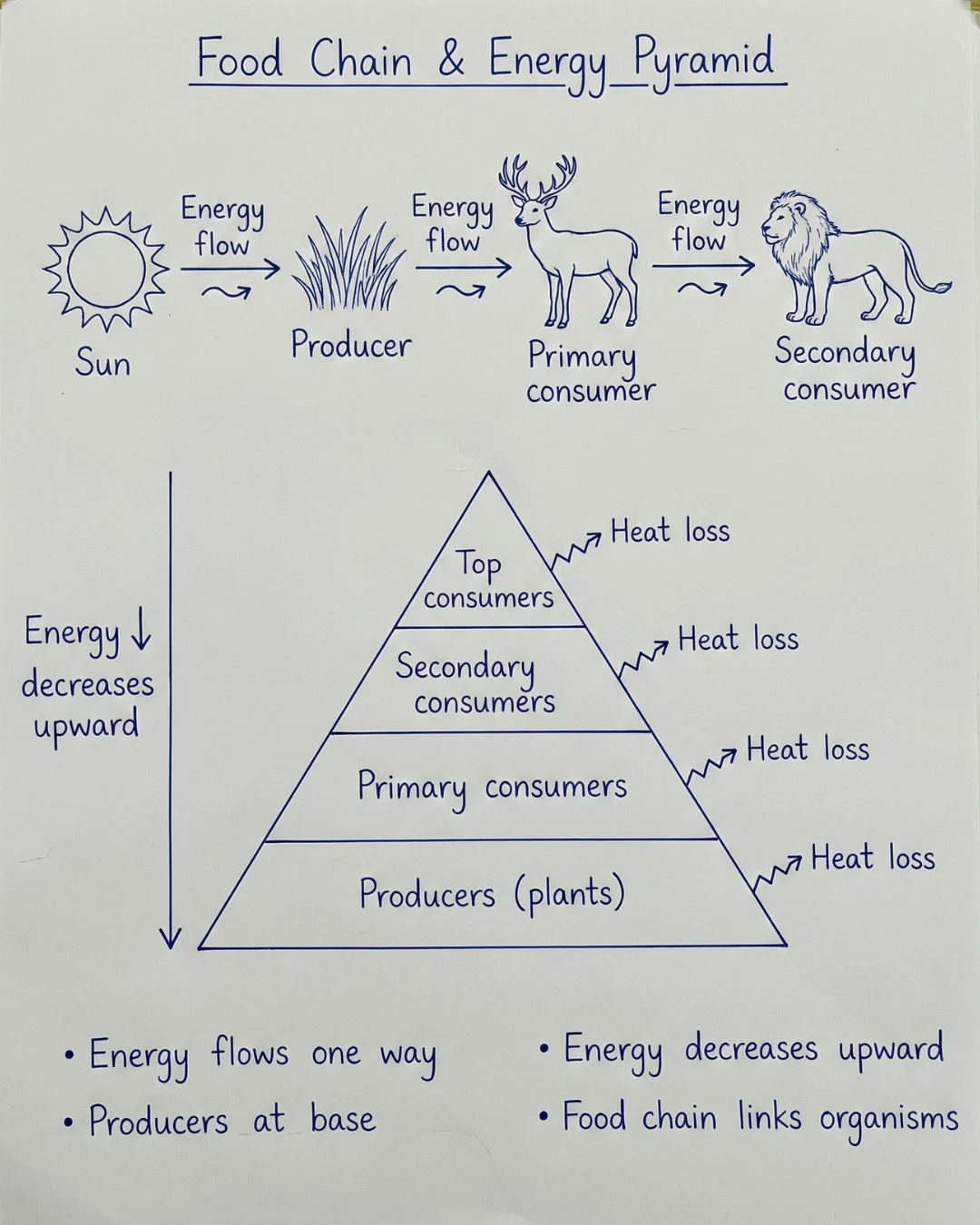
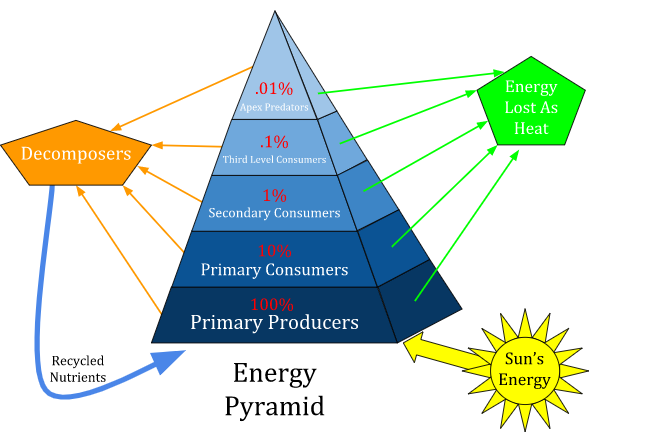
Each level in the food chain is called a trophic level. The amount of matter and energy gradually decreases from the producer at the lowest level to the top consumer at the highest level.
An energy pyramid is a graphical model that illustrates the flow of energy through an ecosystem's different feeding, or trophic, levels. It shows that the amount of available energy decreases significantly as you move up the food chain — which is why the levels become progressively smaller toward the top.
10% Rule of Energy Flow
The 10% rule of energy transfer from one trophic level to the next is credited to Raymond Lindeman (1942). According to this law, only 10% of energy is transferred from one level to the next — the rest is lost into the atmosphere. This energy is stored in various organic products in plants from the sun via the process of photosynthesis, then passed on to the primary consumer when a herbivore consumes the plant as food. The conversion of chemical energy then occurs through its conversion into heat.
The energy flow is: Primary producer (100%) → First level / primary consumer (10%) → Second level / secondary consumer (1%) → Third level / tertiary consumer (0.1%). The energy flow in the ecosystem is unidirectional.
Chapter 7 — Practice Questions (Part 1)
Look at a simple pond ecosystem with a heron, fish, insects, frogs, and an aquatic plant.
- What is happening in this ecosystem?
- What evidence shows that organisms depend on one another?
a. Which organism is a primary consumer?
- Grass
- Grasshopper
- Frog
- Snake
b. If the frog population suddenly decreases, which change is most likely to occur first?
- Increase in grasshoppers
- Increase in eagles
- Decrease in snakes
- Increase in grass
What is the original source of energy in this ecosystem?
- Soil
- Water
- Sun
- Air
Which statement is correct?
- Energy is recycled in an ecosystem.
- Energy flows in one direction (unidirectional).
- Consumers produce energy.
- Predators receive maximum energy.
According to the 10% law of energy, if grass stores 10,000 J of energy, how much energy will be available to the grasshopper?
Draw a food web using the following organisms and identify one producer, two primary consumers, and one tertiary consumer: Grass, Rabbit, Mouse, Snake, Hawk, Grasshopper.
Why is a food web more stable than a single food chain?
Bio-Geo-Chemical Cycle
The term biogeochemical is derived from "bio" meaning biosphere, "geo" meaning geological components, and "chemical" meaning the elements that move through a cycle.
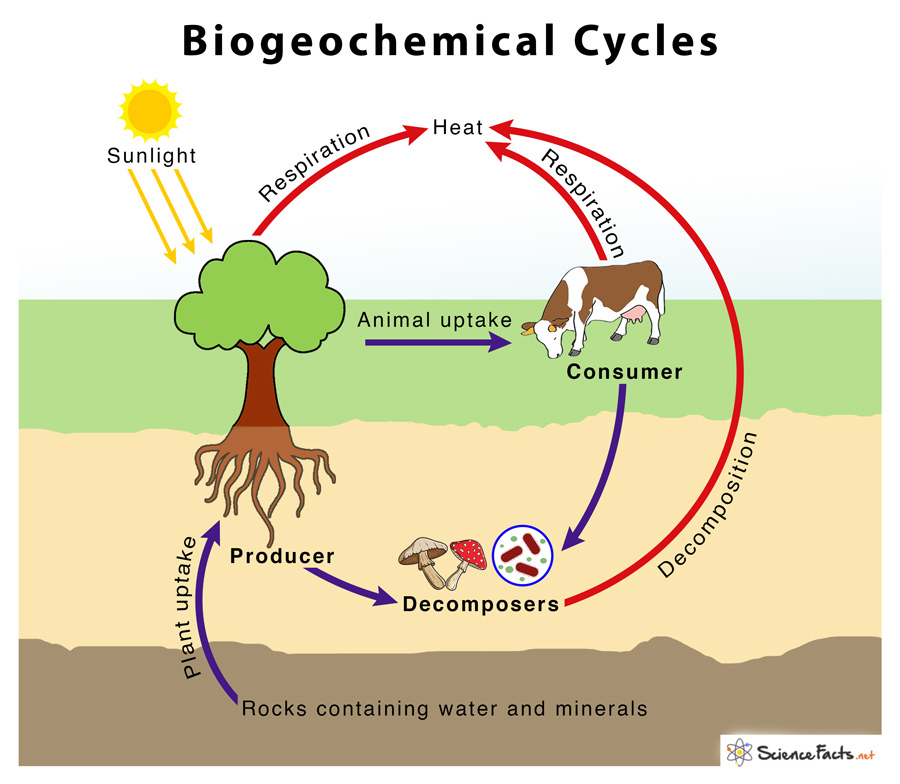
In earth science, a biogeochemical cycle is the pathway by which a chemical substance moves through both biotic and abiotic components of the Earth. While energy flow in an ecosystem is one-way, the flow of nutrients is cyclic — all organisms need nutrients for their growth. This cyclical flow of nutrients within an ecosystem is called the bio-geo-chemical cycle.
Nutrients necessary for the growth of organisms are continuously transferred from abiotic to biotic factors and back again within an ecosystem. This cycle operates continuously through the medium of the biosphere, formed by the lithosphere, atmosphere, and hydrosphere.
Cycling Elements
- Macronutrients: Required in relatively large amounts — the "big six": carbon, hydrogen, oxygen, nitrogen, phosphorus. Other macronutrients include sulfur, potassium, calcium, iron, and magnesium.
- Micronutrients: Required in very small amounts (but still necessary): boron, copper, molybdenum.
Types of Biogeochemical Cycle
Biogeochemical cycles can be classified as:
Gaseous Cycle: Refers to the transformation of gases between various biogeochemical reservoirs — hydrosphere, atmosphere, and biosphere. Important gaseous cycles are the Nitrogen Cycle, Oxygen Cycle, Carbon Cycle, and Water Cycle.
Sedimentary Cycle: Includes the leaching of minerals and salts from the Earth's crust, which then settle as sediment or rock before the cycle repeats. Important sedimentary cycles are the Phosphorus Cycle, Sulfur Cycle, Iron Cycle, and Calcium Cycle. Sedimentary cycles vary from one element to another, but each consists fundamentally of a solution phase and a sediment phase.
Difference Between Gaseous Cycle and Sedimentary Cycle
| Gaseous Cycle | Sedimentary Cycle |
|---|---|
| Main abiotic gaseous nutrient material accumulates in the Earth's atmosphere. | Main abiotic nutrient material accumulates in soil, sediment, and sedimentary rocks. |
| Includes nitrogen, oxygen, carbon dioxide, water vapour, etc. | Includes soil components like iron, calcium, phosphorus, etc. |
| Fast and dynamic — elements move quickly between living things and the atmosphere. | Slow — elements can be locked in rock for millions of years. |
| Highly global — gases mix rapidly across the globe. | More localized — relies on physical weathering and leaching. |
| Rarely suffers from long-term immobilization; nutrients readily re-enter the cycle. | Nutrients can easily get buried in deep ocean sediments, becoming unavailable for eons. |
| Example: Carbon, Nitrogen, Oxygen, and Water. | Example: Phosphorus, Sulfur, and Calcium. |
The Carbon Cycle
Meaning: The circulation and recycling of carbon from the atmosphere to living organisms, and after their death back to the atmosphere, is called the carbon cycle. Abiotic carbon atoms are circulated and recycled into biotic form mainly through photosynthesis and respiration, making the carbon cycle one of the most important biogeochemical cycles.
Process: Plants convert carbon dioxide into carbohydrates through photosynthesis, and similarly produce carbon compounds like proteins and fats. Herbivores feed on plants, carnivores feed on herbivores — this is how biotic carbon transfers from plant to herbivore, herbivore to carnivore, and carnivore to apex consumer. After death, all consumers are decomposed by decomposers like bacteria and fungi, and carbon dioxide is released back into the atmosphere to be used again by living organisms.
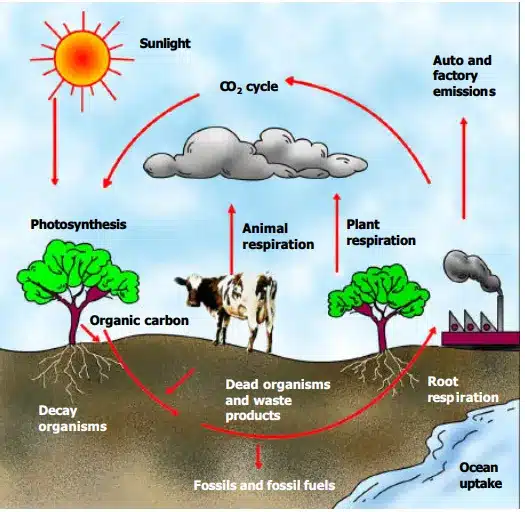
Conclusion: Carbon is continuously passed on from one living organism to another. After the death of a living organism, carbon goes to the atmosphere and is again taken up by living organisms.
The Oxygen Cycle
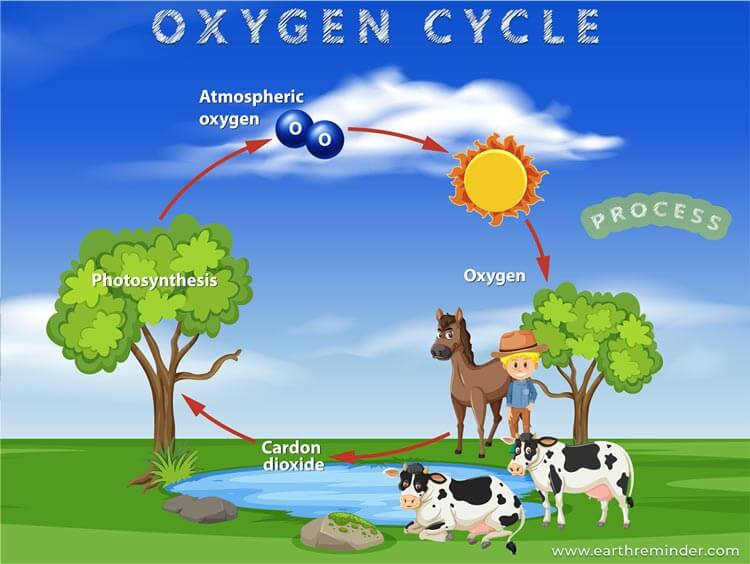
Meaning: Oxygen makes up 21% of the atmosphere and is also present in the hydrosphere and lithosphere. The circulation of oxygen between biotic and abiotic components within the atmosphere is known as the oxygen cycle — oxygen is continuously produced as well as used up.
Process of the oxygen cycle:
- Stage 1: All green plants, during photosynthesis, release oxygen back into the atmosphere as a by-product.
- Stage 2: All aerobic organisms use free oxygen for respiration.
- Stage 3: Animals exhale carbon dioxide back into the atmosphere, which is again used by plants during photosynthesis — keeping oxygen balanced within the atmosphere.
Conclusion: Oxygen is highly reactive and readily reacts with other compounds. It is found in various forms like molecular oxygen (O₂), water (H₂O), and carbon dioxide (CO₂). Oxygen is released in processes like respiration, combustion, decomposition, corrosion, and rusting.
Chapter 7 — Practice Questions (Part 2)
A drought causes a severe shortage of water.
- Which group will be affected first — producers or consumers? Give reasons.
- Explain how one abiotic factor can influence all trophic levels of an ecosystem.
Which biogeochemical cycles are represented simultaneously?
- Carbon and sulphur
- Water and nitrogen
- Oxygen and phosphorus
- Carbon and oxygen
Which process returns the maximum amount of carbon directly to the atmosphere?
- Photosynthesis
- Respiration
- Nitrogen fixation
- Transpiration
Which sequence correctly represents the movement of carbon from atmosphere to animal?
- Atmosphere → Animal → Plant
- Atmosphere → Plant → Animal
- Atmosphere → Fossil fuels → Animal
- Atmosphere → Decomposer → Animal
A city cuts down 50% of its trees. Predict the long-term effect on the oxygen cycle and justify your answer.
Why is the oxygen cycle considered essential for maintaining life on Earth?
Assertion (A): Deforestation increases atmospheric CO₂ concentration.
Reason (R): Trees absorb CO₂ during photosynthesis.
- Both (A) and (R) are true, and (R) explains (A).
- Both are true, but (R) does not explain (A).
- (A) is true, (R) is false.
- (A) is false, (R) is true.
The Nitrogen Cycle
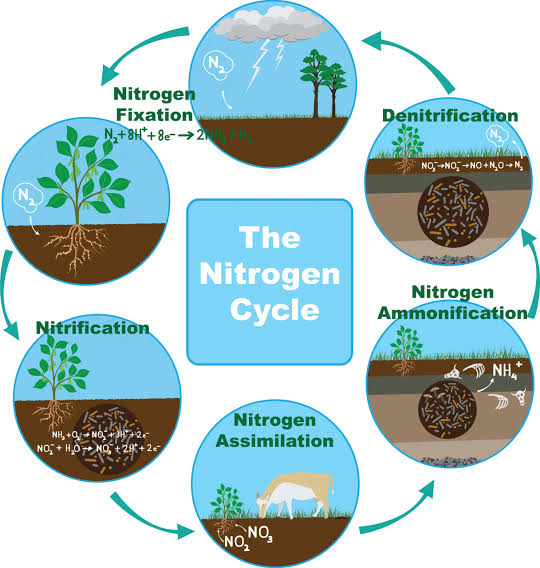
The nitrogen cycle is a repeating cycle of processes during which nitrogen moves through both living and non-living things: the atmosphere, soil, water, plants, animals, and bacteria. To move through the different parts of the cycle, nitrogen must change forms. In the atmosphere, nitrogen exists as a gas (N₂), but in soils it exists as nitrogen oxide (NO) and nitrogen dioxide (NO₂), and when used as a fertilizer, it can be found in other forms, such as ammonia (NH₃), which can be processed further into ammonium nitrate (NH₄NO₃).
There are five stages in the nitrogen cycle:
1. Nitrogen Fixation
Nitrogen moves from the atmosphere into the soil. Earth's atmosphere contains a huge pool of nitrogen gas (N₂), but this nitrogen is "unavailable" to plants because the gaseous form cannot be used directly without transformation. Fixation converts atmospheric nitrogen into forms that plants can absorb through their root systems.
A small amount of nitrogen can be fixed when lightning provides the energy needed for N₂ to react with oxygen, producing nitrogen oxide and nitrogen dioxide, which then enter soils through rain or snow. Nitrogen can also be fixed industrially, under high heat and pressure, by combining atmospheric nitrogen and hydrogen to form ammonia, which can be processed further into ammonium nitrate for use in soils.
2. Nitrogen Assimilation
Inorganic nitrogen in the form of nitrates, nitrites, and ammonia is absorbed by green plants through their roots and converted into nitrogenous organic compounds. Nitrates are first converted into ammonia, which combines with organic acids to form amino acids — used in the synthesis of proteins, enzymes, chlorophyll, nucleic acids, etc.
Ammonification
The process of releasing ammonia by certain microorganisms utilizing organic compounds derived from the dead remains of plants and animals. The microorganisms especially involved are Actinomycetes and bacilli (Bacillus ramosus, B. vulgaris, B. mesentericus).
3. Nitrification
Nitrification occurs in soils and is the conversion of ammonia into nitrites and then nitrates by Nitrosomonas and Nitrobacter bacteria in the presence of oxygen. Nitrates can be used by plants and by animals that consume those plants.
- Nitrosomonas → changes ammonia (NH₃) into nitrites (NO₂−)
- Nitrobacter → changes nitrites (NO₂−) into nitrates (NO₃−)
Both bacteria need oxygen (O₂) to carry out this process, and during these reactions the bacteria get energy for their growth and activities. Nitrates are easily absorbed by plant roots, so nitrification helps plants get the nitrogen they need for growth.
Denitrification
The fifth stage of the nitrogen cycle — nitrogen returns to the air as nitrates are converted to atmospheric nitrogen (N₂) by bacteria. This results in an overall loss of nitrogen from soils, as the gaseous form of nitrogen moves back into the atmosphere.